
Growth6 min read
By Dmitry Krotov, CEO and co-founderRunning marketing for US moving companies since 2016Updated
Stop Being the Firefighter: Why Speed and Systems Beat Strength in the Moving Industry

Here is the uncomfortable truth about the moving industry in 2026: being the best mover in your city does not matter if someone else answers the phone first. The companies winning right now are not the ones with the biggest trucks or the strongest crews. They are the ones with the fastest systems.
Most moving company owners built their businesses on hard work, reputation, and word of mouth. Those things still matter. But they are no longer enough. The gap between a good moving company and a growing moving company is not about quality of service. It is about speed of response.
If your lead response time is measured in hours, or worse, "when we get back to the office," you are handing revenue to competitors who respond in seconds.
The Firefighter Trap
Most moving company owners operate as firefighters. A truck breaks down, they handle it. A customer complains, they take the call. A lead comes in, they try to get to it between everything else. The entire business runs through one person, and that person is always putting out fires.
This is not a growth strategy. This is survival mode. And when you are stuck in survival mode, leads slip through the cracks. Not because you do not care, but because you physically cannot be everywhere at once.
The firefighter trap is the single biggest reason moving companies plateau between $500K and $2M in revenue. The owner becomes the bottleneck. Every decision, every quote, every follow-up runs through them. And the moment they step away, the machine stops.
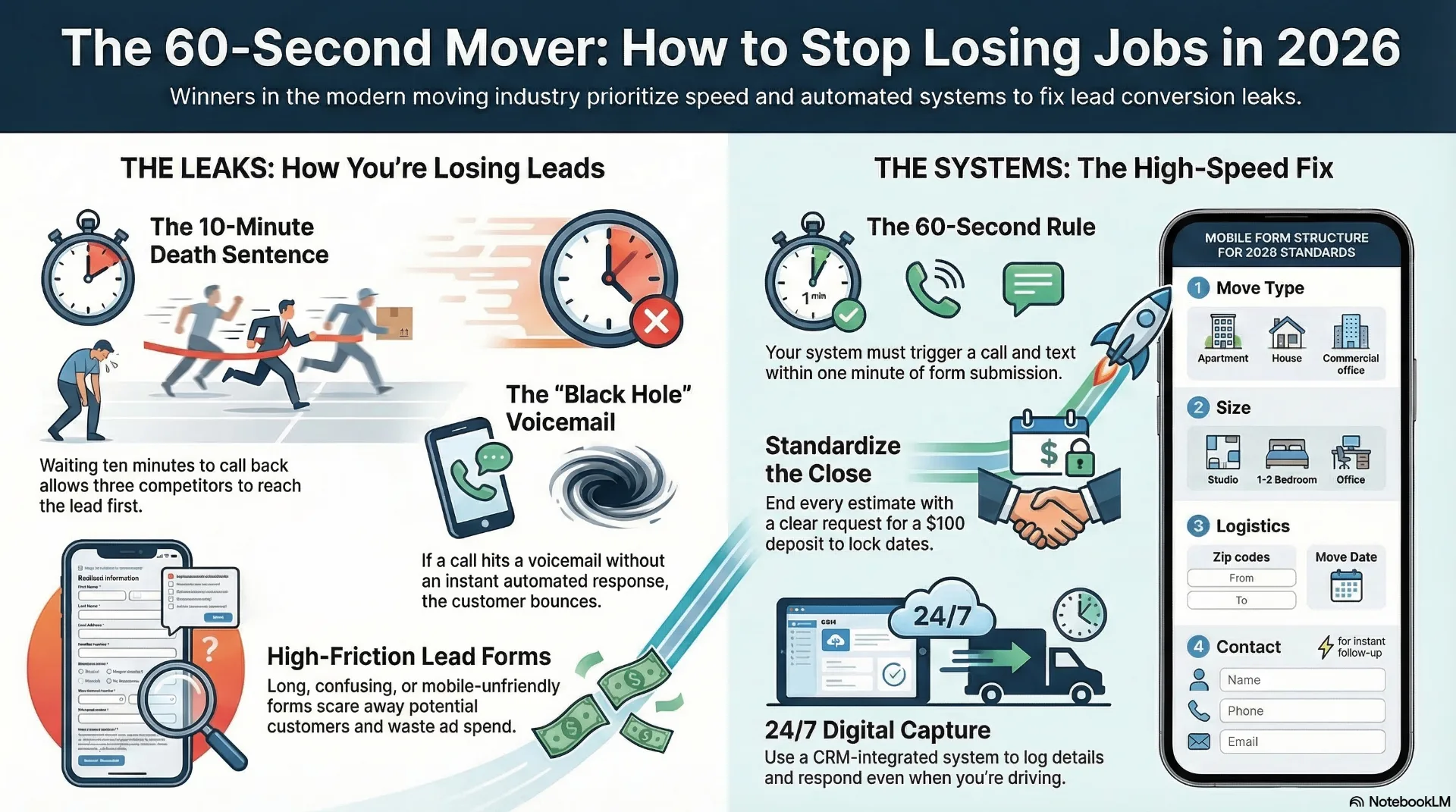

The 60-Second Rule
The lead response research shows why: calling a web lead within 5 minutes rather than 30 makes you 100x more likely to reach them and 21x more likely to qualify them (MIT/InsideSales Lead Response Management Study, 2007). Not the cheapest company. Not the most experienced. The fastest.
Think about that from the customer's perspective. Someone is planning a move. They are stressed, overwhelmed, and looking for someone to take the problem off their plate. They submit a form or call three companies. The one that responds within 60 seconds feels like the professional choice. The one that calls back four hours later feels like an afterthought.
Modern moving companies need an automated 60-second follow-up protocol for every single inquiry. Not "we will get to it soon." Not "the office manager will call when she is free." Every lead, every time, within 60 seconds. That is the new standard.
The Best Mover Does Not Win. The Fastest System Does.
This is the mindset shift most owners resist. They built their company on doing great work. They take pride in their crews, their care with furniture, their customer service. And they should. But none of that matters if the customer never gets on the phone with them in the first place.
The competition is no longer about who is the best mover. It is about who has the best lead conversion system. The companies booking 30, 40, 50 jobs a month are not necessarily better movers. They are better at capturing and converting leads before anyone else gets the chance.
That means mobile-friendly quote forms that take 30 seconds to fill out. It means instant text and email confirmations. It means automated follow-up sequences that nurture leads who are not ready to book today but will be ready next week. It means removing every point of friction between "I need a mover" and "I just booked one."
Kill the Long Form
Take a hard look at your website right now. If your quote form asks for 10+ fields on a single page, you are losing leads. Every additional field you add to a form drops your conversion rate. A customer who is browsing on their phone while eating lunch is not going to fill out a form that looks like a mortgage application.
The fix is simple: multi-step forms. Break the process into three or four quick screens. First screen: move date and zip codes. Second screen: home size and special items. Third screen: name, phone, email. Each step feels easy. Each click creates micro-commitment. By the time they reach the end, they have already invested 30 seconds and they are far more likely to hit submit.
Companies that switch from a single long form to a multi-step process see conversion increases of 40-60%. That is not a marginal improvement. That is the difference between 20 leads a week and 32 leads a week, from the exact same traffic.
Standardized Sales Scripts Are Not Optional
Here is what happens at most moving companies: a lead calls in, and whoever answers the phone wings it. Sometimes they are great. Sometimes they forget to ask for the email. Sometimes they give a quote without qualifying the lead. There is no consistency, which means there is no predictability.
Top-performing moving companies use standardized sales scripts for every type of inquiry. Not robotic, word-for-word scripts, but structured frameworks that ensure every conversation hits the same key points: qualify the lead, build urgency, capture contact info, and set the next step.
When you combine scripted conversations with AI-powered call handling, you get consistency at scale. Every call is answered the same way, every lead is qualified the same way, and every follow-up happens on schedule, whether it is 2 PM on a Tuesday or 9 PM on a Saturday.
Automated Booking: Remove Yourself From the Process
The ultimate goal is a booking process that does not require you. A lead comes in, the system responds instantly, qualifies the inquiry, provides an estimate range, and books a visual survey or confirms the job. You wake up in the morning and see three new bookings in your CRM that happened while you were asleep.
This is not a fantasy. This is what the top 5% of moving companies are already doing. They use AI voice agents to answer calls 24/7. They use automated SMS sequences to follow up with leads who did not book on the first contact. They use CRM integrations that update in real time so nothing falls through the cracks.
The owner's job shifts from "doing everything" to "reviewing the dashboard." Instead of being the firefighter, you become the architect of a system that runs without you.
Speed Is the New Competitive Advantage
The moving industry is more crowded than ever. In most metros, there are dozens of companies competing for the same leads. The differentiator is no longer who has the best Yelp reviews or the nicest trucks. It is who captures the lead first.
Systematic speed and efficiency are the primary drivers of growth in this market. Every minute you delay a response is a minute your competitor uses to close that deal. Every manual step in your process is an opportunity for a lead to get distracted, call someone else, or just move on.
The companies that will dominate in 2026 and beyond are not the ones with the biggest ad budgets. They are the ones that built systems to convert every lead they already have, faster than anyone else.
The Playbook: What to Do This Week
Four moves, in order. If you want the full version of this with tools and costs, it is in the complete AI playbook for movers.
If you are reading this and recognizing yourself in the firefighter role, here is where to start:
- Audit your response time. Have someone submit a form on your website. Time how long it takes for your team to respond. If it is over five minutes, you have a problem.
- Replace your long form with a multi-step process. Three to four screens max. Mobile-first design. Make it feel effortless.
- Implement a 60-second follow-up rule. Every lead gets an automated text and email within one minute. No exceptions.
- Create a sales script framework. Document the five key questions every phone conversation must cover. Train your team or let AI handle it.
- Automate your follow-up sequence. Leads that do not book on day one should get a follow-up on day two, day four, and day seven. Automatically.
None of this requires a massive investment. It requires a decision: stop being the firefighter and start building the system. The moving companies that make this shift will grow. The ones that do not will keep wondering why their competitors are booking more jobs with less effort.
Ready to Stop Fighting Fires?
See how Boosted Movers helps moving companies automate lead capture, follow-ups, and booking so owners can stop being the bottleneck.
See How It WorksRead next50 AI Voice Agents Built. Here's What I Learned.
Read a few of these?
You can tell Google to favor Boosted Movers in your own search results and AI Overviews. One click, and it only changes what you see.
Add as a preferred source on Google