Technology6 min read
By Dmitry Krotov, CEO and co-founderRunning marketing for US moving companies since 2016
Stop Juggling Tools: How Top Movers Combine Everything Into One AI System

You have got LiveSwitch for video estimates. Snoball for referrals and reviews. A CRM for lead tracking. A phone system for inbound calls. Maybe a separate follow-up tool. And somehow, your team is supposed to juggle all of it while actually moving furniture. Sound familiar?
Here is what the most successful moving companies figured out in 2026: the tools themselves are not the problem. The problem is that they are disconnected. Every tool is a silo, and every silo creates a gap where leads, revenue, and customer experience fall through the cracks.
The movers winning right now are not adding more tools. They are combining them into one unified AI system, a Revenue Operating System, that manages the entire customer journey from the first phone call to the post-move review request.
The Tool Sprawl Problem Nobody Talks About
Let us be honest about the typical moving company tech stack in 2026. Most owners have accumulated tools over the years, each solving one specific problem:
| Tool | What It Does | The Gap It Creates |
|---|---|---|
| LiveSwitch | Video surveys and virtual estimates | Who schedules the survey? Who follows up if the customer no-shows? |
| Snoball | Automated referrals and review requests | Who triggers the referral request at the right moment? Who handles the incoming referral call? |
| CRM (SmartMoving, etc.) | Lead tracking and job management | Data is only as good as whoever remembers to update it |
| Phone system | Inbound call handling | Missed calls after hours, no outbound follow-up |
| Email/SMS tool | Drip campaigns and reminders | Generic messages, no awareness of call outcomes |
Each tool works fine on its own. But together? They create a Frankenstein operation where your staff becomes the glue, manually moving data between systems, remembering to trigger the next step, and hoping nothing slips through.
And things always slip through.
What a Unified System Actually Looks Like
A Revenue Operating System does not replace your favorite tools. It connects them into one intelligent workflow where the AI manages the handoffs that your staff used to forget.
Here is the full customer journey in a unified system:
Stage 1: First Contact
Customer calls at 8 PM. AI agent answers, qualifies the lead, captures move details.
Lead is created in CRM automatically with full call summary and move specs.
AI schedules a LiveSwitch video survey for the next available slot and sends the customer a confirmation.
Stage 2: Estimate & Close
If the customer no-shows the video survey, AI calls them back within 30 minutes to reschedule.
After the estimate is sent, AI follows up to answer questions and handle objections.
CRM status updates automatically at every step. No manual entry required.
Stage 3: Post-Move & Referrals
After the move, AI triggers a satisfaction check call. Happy customer? Snoball referral request goes out automatically.
When that referral calls in, the AI answers, qualifies them, and the cycle starts again. Zero human intervention needed.
That is not a fantasy. That is what happens when you stop treating each tool as a standalone product and start treating them as components in one system.
Why "Best-of-Breed" Fails Without a Brain
The moving industry loves the idea of picking the "best" tool for each job. And individually, tools like Snoball and LiveSwitch are excellent at what they do. Snoball automates word-of-mouth marketing better than any manual referral program. LiveSwitch makes virtual estimates faster and more accurate than phone-based guesses.
But here is the math nobody does: the gaps between tools cost more than the tools themselves.
The hidden cost of disconnected tools:
15-20 minutes per lead spent manually updating CRM after each call, video survey, or follow-up
30-40% of referrals never contacted because the review-to-referral handoff depends on someone remembering to act
Video survey no-shows abandoned because there is no automated re-engagement process
After-hours leads lost even though AI tools exist, because they are not connected to your scheduling and CRM
With an average lead value of $900 in the moving industry, losing even five leads per month to tool-gap friction costs you $54,000 a year. That is not a technology problem. That is an integration problem.
The Revenue Operating System Framework
A true Revenue Operating System has three layers. If any layer is missing, you still have tool sprawl wearing a trench coat.
| Layer | Function | Examples |
|---|---|---|
| 🧠 AI Brain | Orchestrates the entire customer journey, makes decisions, triggers actions | AI voice agent that qualifies leads, follows up, re-engages, and routes tasks |
| 🔗 Integration Layer | Connects specialized tools so data flows automatically between them | CRM updates, LiveSwitch scheduling, Snoball triggers, SMS confirmations |
| 📊 Accountability Layer | Everything logged in CRM, creating a single source of truth | Call recordings, survey outcomes, referral tracking, revenue attribution |
The AI brain is the key differentiator. Without it, you need humans to manage the handoffs between tools. With it, the system runs autonomously and only escalates to your team when a real decision is needed.
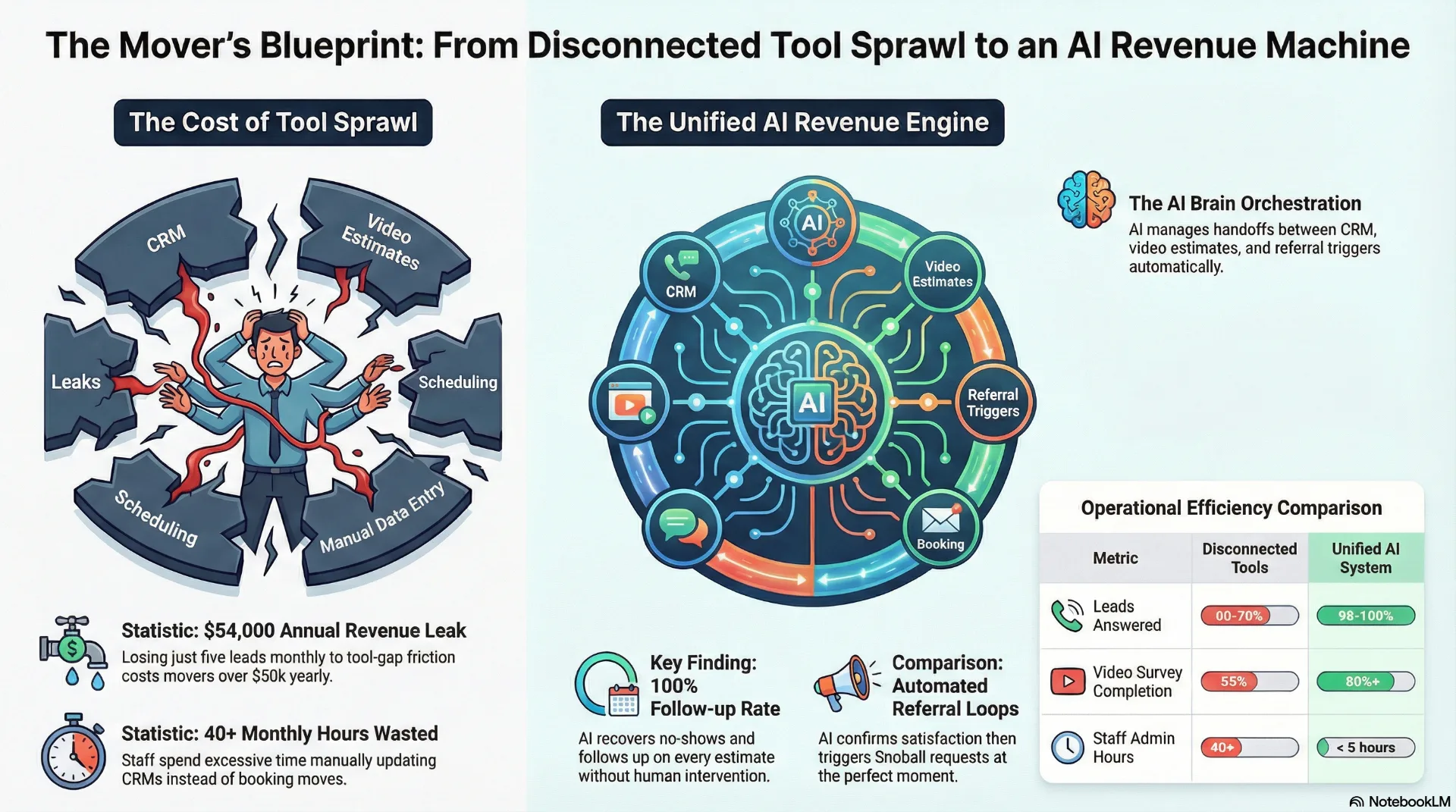
The Mover's Blueprint: From Disconnected Tool Sprawl to an AI Revenue Machine
Real Example: From First Call to Referral in One System
Let us walk through how a Revenue Operating System handles a single customer from start to finish, with no manual handoffs.
Sarah calls about a 3-bedroom move. AI answers, qualifies the lead, and books a LiveSwitch video survey for Wednesday at 10 AM. CRM updated automatically.
Sarah does not join the video survey. AI calls her 30 minutes later, reschedules for Thursday. CRM status: "Survey Rescheduled."
Video survey completed via LiveSwitch. Estimate generated and sent. CRM status: "Estimate Sent."
No response from Sarah. AI calls to follow up: "Hi Sarah, just checking if you had any questions about the estimate." Sarah books the job. CRM status: "Booked."
AI calls Sarah for a satisfaction check. She is thrilled. AI triggers Snoball referral request. Sarah refers two colleagues who are also relocating.
One referral calls in. AI answers, qualifies, books a video survey. The cycle repeats, zero human intervention required.
That is seven touchpoints across four different tools, all orchestrated by one AI system, with every action logged in CRM. No office staff needed until someone actually needs to show up with a truck.
What This Means for Your Referral Machine
Snoball is a powerful platform. But its effectiveness depends entirely on timing. Ask for a referral too late and the customer has moved on. Ask too early and they have not experienced your service yet. Do it manually and it simply does not happen consistently.
When an AI system manages the post-move experience, the referral trigger happens at exactly the right moment, every single time. The AI calls after the move, gauges satisfaction, and if the response is positive, fires the Snoball referral request immediately.
Manual referrals vs. AI-triggered referrals:
Manual Process
- ✗ Depends on staff remembering after each move
- ✗ Inconsistent timing reduces response rates
- ✗ Unhappy customers accidentally get referral requests
- ✗ Referral leads sit uncontacted for hours or days
AI-Triggered
- ✓ Satisfaction confirmed before referral request fires
- ✓ Every completed move triggers the process automatically
- ✓ Referral leads answered instantly by AI, 24/7
- ✓ Full cycle tracked in CRM with revenue attribution
What This Means for Video Estimates
LiveSwitch gives your team superpowers for estimating. But the biggest bottleneck is not the video call itself. It is everything around it: scheduling, no-show recovery, estimate follow-up, and closing the deal.
When an AI system wraps around your video estimate process, those bottlenecks disappear:
AI books the survey during the initial lead call, no manual scheduling needed
Sends reminders via SMS and call before the scheduled time
Recovers no-shows with an immediate callback and reschedule offer
Follows up on estimates that have not been accepted within 24-48 hours
Handles objections on the follow-up call ("That is a bit more than I expected...")
The ROI of Unification
Here is the simple math. If you are running a moving company with 100 leads per month and an average job value of $900:
| Metric | Disconnected Tools | Unified System |
|---|---|---|
| Leads answered (incl. after-hours) | 60-70% | 98-100% |
| Video survey completion rate | 55% | 80%+ |
| Estimate follow-up rate | 40% | 100% |
| Post-move referral requests sent | 20% | 95%+ |
| Monthly staff hours on admin | 40+ hrs | <5 hrs |
Even a modest improvement in conversion rate from better follow-ups and no-show recovery adds 5-10 booked jobs per month. At $900 each, that is $54,000-$108,000 in annual revenue from the same lead volume.
How to Build Your Unified System
You do not need to rip out every tool and start over. The smartest approach is to layer an AI brain on top of your existing stack:
Start with CRM integration
Your CRM is the foundation. Make sure your AI agent lives inside it and every action is logged there.
Connect your estimate process
Link LiveSwitch (or your preferred video tool) so the AI can schedule, remind, and recover surveys automatically.
Add post-move automation
Connect Snoball or your referral system so the AI triggers review and referral requests based on job completion and satisfaction signals.
Close the loop on referral leads
Ensure incoming referral calls are handled by the same AI system, so the entire cycle repeats without human intervention.
The Bottom Line
The moving companies that will dominate in 2026 and beyond are not the ones with the most tools. They are the ones with the best-connected systems. LiveSwitch, Snoball, and your CRM are all powerful on their own, but when they operate as components inside a Revenue Operating System with an AI brain managing the handoffs, they become something entirely different.
They become a machine that turns every lead into a customer, every customer into a review, and every review into a referral, automatically.
Ready to unify your tech stack?
See how a Revenue Operating System connects your CRM, video estimates, and referral engine into one intelligent workflow. Book a 15-minute demo and we will map it to your exact setup.
Stop losing $900 jobs to your own voicemail.
Fifteen minutes. We look at your call volume and show you exactly where the jobs are leaking.
Read nextWhat Makes an Effective AI Agent for Moving Companies? The Complete Checklist
Read a few of these?
You can tell Google to favour Boosted Movers in your own search results and AI Overviews. One click, and it only changes what you see.
Add as a preferred source on Google