
AI Visibility7 min read
By Dmitry Krotov, CEO and co-founderRunning marketing for US moving companies since 2016
What 41 AI Visibility Audits Taught Us About Moving Companies
Your next customer might not Google "movers near me." A growing share ask ChatGPT, or take the answer Google's AI writes at the top of the page. Either way, a machine now decides which movers get named.
Machines do not guess. They read signals: the pages on your site, the code behind it, whether your business details match across the web. Over the past two months we audited 41 moving companies and scored exactly those signals.
In the 39 audits where we scored AI readiness, the average was 49 out of 100.
Not because these are bad companies. Most had solid reviews and real crews. Their websites just never told the machines any of it. Here is what we found, ranked by how often we found it.
1. No pages for the cities you actually serve
31 of 41 companies (76%).
When someone asks for "movers in Carlsbad," Google and the AI assistants look for a page about moving in Carlsbad. Most movers do not have one. We audited companies whose entire website was one page. We audited companies with dozens of pages and still not one for a town on their trucks' routes.
Your trucks cover fifteen towns. Your website mentions one, usually in passing. The movers outranking you keep a dedicated page for every town they serve, and that is most of the reason they outrank you.
2. Your business is not written in code
28 of 41 companies (68%).
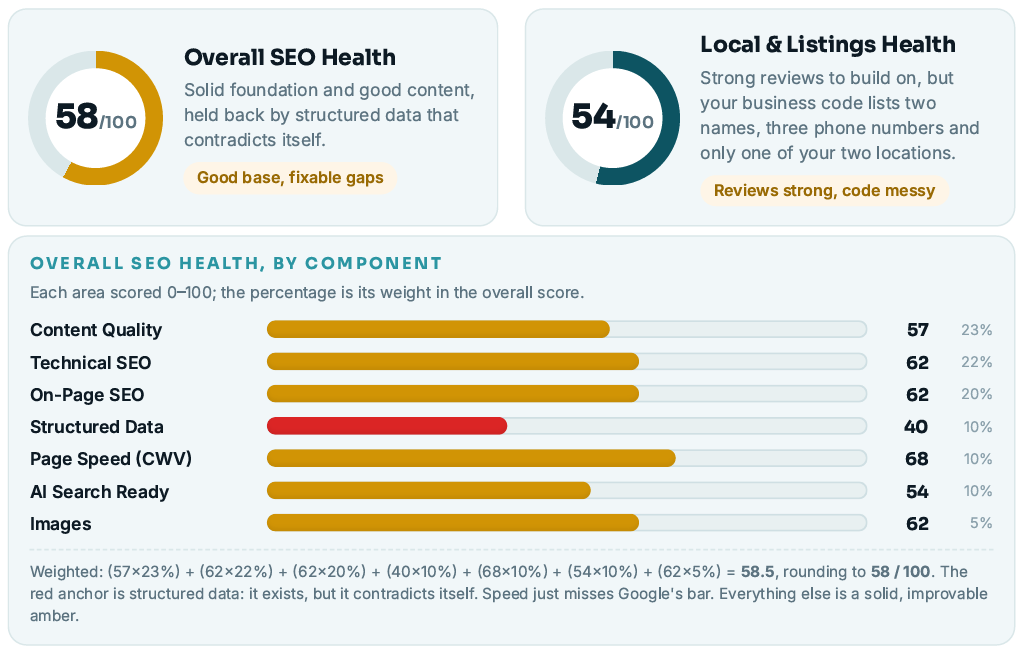
Websites carry a hidden layer of code, called schema, that tells machines what the business is: name, address, services, hours, rating. Think of it as your business card for robots.
In 28 audits that card was missing, empty, or broken. The average structured data score was 42 out of 100 (scored in 39 of the 41 audits). On local business code specifically, the average was 30, scored in 30 audits, the lowest number in our entire dataset. Several sites were tagged in code as a generic "website," nothing more. A human sees a moving company. A machine sees nothing to recommend.
3. Your own records disagree with each other
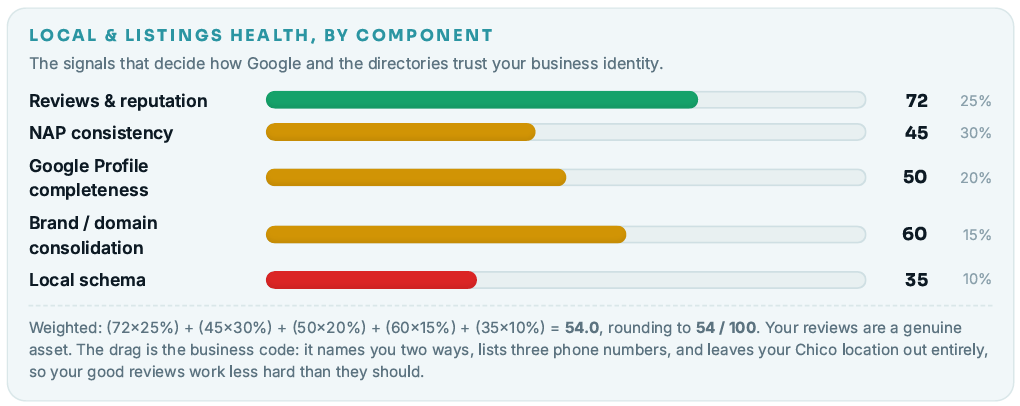
We scored name, address, and phone consistency in 34 of the 41 audits. 21 of those 34 (62%) came in below 50 out of 100.
Two phone numbers in circulation. A phone number on the website that does not match the one on the federal record. A founder named three different ways on three different pages. Each mismatch looks small. Machines read them differently: when the facts about a business disagree, every fact becomes less trustworthy, and a less trusted business gets recommended less. This is the quietest problem on the list and one of the cheapest to fix.
4. Reviews the machines cannot see
22 of 41 companies (54%).
Almost every company we audited had genuinely good reviews. But the reviews lived in a widget, a screenshot, or another website, places where crawlers cannot read them. In code, where the machines look, the rating did not exist.
You earned that reputation one move at a time. If it is not written where machines can read it, it works at a fraction of its strength.
5. Too slow on the phones your customers hold
18 of 41 companies (44%).
Google's own field data, measured from real visitors, flagged these sites as slow on phones. In the worst cases the main content took 5, 9, even 21 seconds to appear. Some sites were getting slower month over month. Speed is a ranking factor, and movers get chosen on phones. Every extra second is a customer who taps back and calls the next name on the list.
These are AI problems with SEO roots
Every finding above sounds like classic SEO. It is. But the same signals now feed a second audience. City pages give AI assistants something to cite. Schema gives them facts to repeat. Consistent records tell them you are safe to recommend. Coded reviews give them a reason to pick you over the mover with no proof.
There are new signals too. 31 of the 41 companies had no llms.txt file, the simple text file that briefs AI crawlers on who you are. Almost nobody in the industry has one yet, which means the movers who add one first are briefing the machines while their competitors stay silent.
This is why the scores land where they do. Of the 39 companies we scored on AI readiness, 18 came in below 50. Not one of the five problems above requires a redesign to fix, and every fix counts twice: once with Google, once with the machines answering your customers' questions.
The old work and the new visibility are the same work. That is the good news.
The pattern behind all of it
None of the 41 companies had seen any of this before our audit. We have been working with American moving companies since 2016, and this is the layer of the internet owners never look at. Not their score, not their broken code, not the gap where their reviews should be. These problems live in a layer of the internet that owners never look at, so nobody fixes them, and the mover who does fix them pulls quietly ahead.
You cannot manage what you have never seen.
See yours free
We run a free AI Visibility Audit for moving companies: your score, what the machines can and cannot read on your site, who is winning your searches, and the one fix we will make for you at no cost so you can judge our work before spending anything.
Get my free AI Visibility AuditData: 41 moving-company audits conducted June to July 2026 by Boosted. Scores use our 0 to 100 model across content, technical SEO, structured data, speed, and AI readiness. Component figures reflect the subset of audits where that component was scored (noted inline). Full methodology available on request.
Read nextThe Quote-to-Deposit Gap: Why 60% of Moving Estimates Never Become Jobs
Read a few of these?
You can tell Google to favor Boosted Movers in your own search results and AI Overviews. One click, and it only changes what you see.
Add as a preferred source on Google