
Industry Research10 min read
By Dmitry Krotov, CEO and co-founderRunning marketing for US moving companies since 2016Updated
The State of Moving Company Marketing 2026
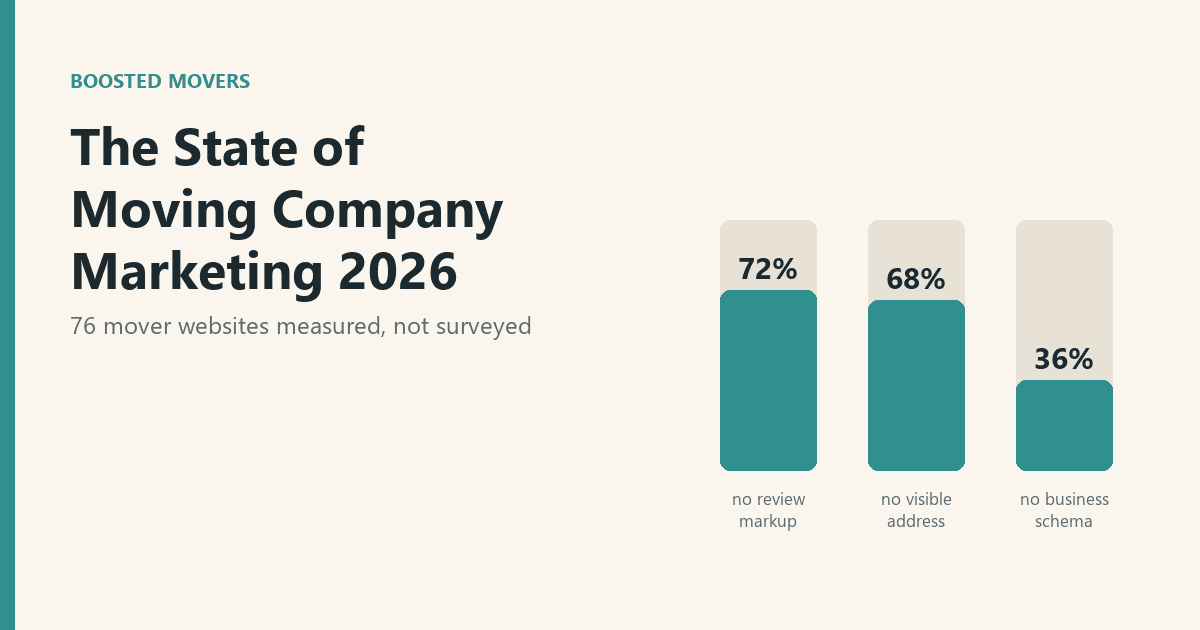
Moving company marketing in 2026 has one defining problem: the industry is spending on demand it cannot capture. Only 38% of moving companies respond to a lead within five minutes (SmartMoving, 2026, 484 companies). Of 76 United States mover websites we verified in August 2026, 55 carried no rating or review markup in their code, 52 showed no street address anywhere on the page, and of the 52 companies claiming to be licensed, bonded or insured, only 27 displayed an actual licence number. The money goes into acquisition. The failures are in being found, being trusted, and answering the phone.
Most industry reports survey opinion. This one measures pages. We did not ask movers how their marketing is going, we read what their websites actually publish, in the form a search engine or an AI assistant reads it.
What did we measure, and how?
Two separate first-party studies, kept separate throughout because they used different methods.
| Study | Sample | Method | Date |
|---|---|---|---|
| Site scan | 76 verified of 101 | Public pages rendered in a real browser | August 2026 |
| Visibility audits | 41 companies | Full manual audit and scoring | 2026 |
A site counted as verified only when its homepage rendered in a real browser and returned enough content to prove the check had run. That distinction matters more than it sounds. A raw HTML check cannot tell a missing review widget from one that loads a second after the page paints, and counting the second as the first would have inflated every number in this report.
Of the 101 companies in the scan, 13 sit behind bot protection that refuses automated access entirely. They are reported as unmeasured, not as clean and not as failing, and nothing about their websites should be inferred from their absence here.
One more limit, stated plainly: these are companies we selected as prospects, not a random draw of the industry. The set likely over-represents websites with visible problems. Read every figure below as a description of that sample rather than a census of American moving.
How visible are moving companies to search and AI in 2026?
Search engines and AI assistants do not read a website the way a customer does. They read the code underneath it. Here is what was missing from that code across the 76 verified sites.
| Signal | Missing | Share |
|---|---|---|
| Rating and review count in the code | 55 of 76 | 72% |
| Street address visible on the page | 52 of 76 | 68% |
| Street address in the structured data | 40 of 76 | 53% |
| Any business schema at all | 27 of 76 | 36% |
| Title tag over 65 characters | 19 of 76 | 25% |
| Title tag under 30 characters | 10 of 76 | 13% |
The review figure is the one that changes how you should read the rest. It does not mean 55 of these companies have no reviews. Of the 21 sites that did carry review markup, the median was 318 ratings, with one at 2,105. These are established businesses with real reputations, storing them somewhere a machine cannot read.
That is the shape of the whole problem. The reputation exists. The proof of it is invisible to the systems that now decide who gets recommended.
Our separate audit of 41 moving companies scored the same weakness from the inside. Average AI readiness was 49 out of 100 across 39 of the 41. Local business schema was the weakest component in the entire dataset at 30 out of 100 across 30 audits, and 31 of the 41 had no llms.txt file at all. Not one of the 41 had seen any of it before we showed them. The full breakdown is in what 41 AI visibility audits taught us.
Do moving companies back up their trust claims?
Half of them do not. This was the single clearest finding in the scan.
This finding is worth more than the others because it compares each site against itself. Whatever you make of our sample, the gap holds inside it: the same page makes a claim and then declines to substantiate it. A customer comparing three movers and an AI assistant summarising those same three have the identical problem telling the licensed operator from the one that merely says so.
A USDOT or state licence number is a few characters of text. It is the cheapest credibility signal available to a moving company, and roughly half the industry is skipping it.
What happens to the leads movers already pay for?
This is where the money actually leaks. According to SmartMoving's 2026 State of Moving Report, based on 484 moving companies, only 38% of movers respond to a lead within five minutes. The other 62% of companies are answering a caller who has already rung the next mover, or not answering at all.
Put that next to what leads cost and the arithmetic stops being abstract. Across nine United States providers, moving leads run $15 to $300 each, and cost per booked job spans $50 to $1,500 depending on the source. The full provider-by-provider breakdown is in the moving company lead providers guide.
A mover buying more leads while answering 38% of them is paying full price for a little over a third of the product. That is the central inefficiency of moving company marketing in 2026, and it is not a marketing problem at all. It is an operations problem wearing a marketing budget.
What does the 2026 picture add up to?
Three findings, in the order they cost money.
- Leads are bought and not answered quickly. 38% of movers respond within five minutes. Every channel decision downstream of that is distorted by it.
- Reputation exists but is unreadable. 72% of verified sites publish no review markup, while the sites that do average hundreds of ratings.
- Trust claims go unsubstantiated. Half the companies claiming a licence show no number, on the one page where proving it is free.
None of the three is a creative problem, a branding problem, or a budget problem, and none of them is new: they are the same gaps behind the trends reshaping the industry this year. All three are things a moving company already has and is failing to make legible: calls it already paid for, reviews it already earned, and credentials it already holds.
For a sense of what the answering side looks like when it is fixed, the two accounts where we measure it directly, Potomac Moving and Dependable Movers, answer 100% of inbound calls with an average time to answer of 6 seconds. That is a measurement on those two accounts rather than a service-wide guarantee, but it is the reference point. The ceiling on any marketing spend is what happens in the first few seconds after the phone rings.
Sources and method
First-party figures are ours and are labelled as such. The scan is reproducible and measures public pages only, with no analytics, no private data and nothing self-reported by the companies.
- Site scan of 101 moving companies, 76 verified, Boosted Movers, August 2026.
- 41 AI visibility audits of moving companies, Boosted Movers, 2026.
- Lead costs by provider, moving company lead providers guide, Boosted Movers, 2026.
- Only 38% of moving companies respond to leads within 5 minutes, SmartMoving 2026 State of Moving Report (484 companies, February 2026).
Using a figure from this report? Cite it as Boosted Movers, The State of Moving Company Marketing 2026, and keep the denominator attached. A percentage without its sample is not a finding.
See Where Your Own Numbers Land
Fifteen minutes. We look at your call volume against the benchmarks above and show you which of the three gaps is costing you most.
Book a DemoOr start with where moving leads actually come from.
Read nextHow to Get Moving Leads in 2026: Seven Channels, Ranked by What They Cost You
Read a few of these?
You can tell Google to favor Boosted Movers in your own search results and AI Overviews. One click, and it only changes what you see.
Add as a preferred source on Google