Industry Insights7 min read
By Dmitry Krotov, CEO and co-founderRunning marketing for US moving companies since 2016
What We Took Away from the MSC Annual Meeting in Nashville 2026
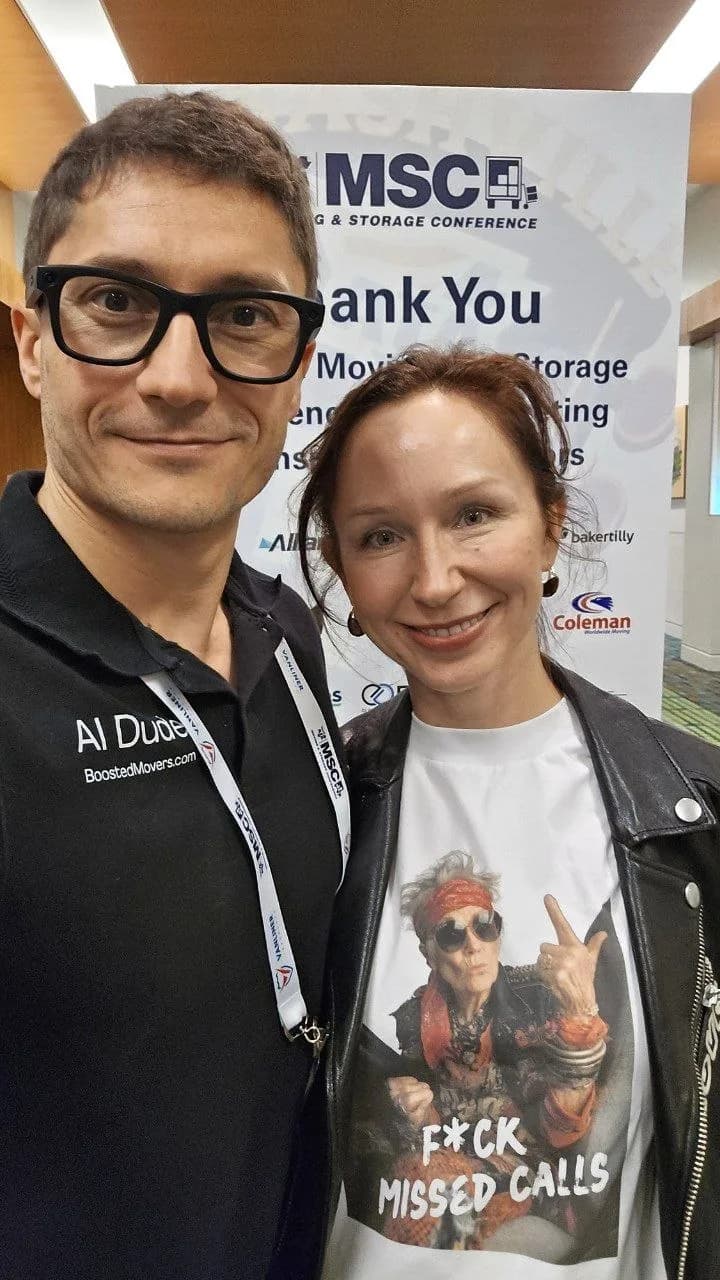
We just got back from the ATA Moving & Storage Conference Annual Meeting in Nashville, and one thing was clear from the first session: the moving industry is at an inflection point. AI is no longer a buzzword on the horizon. It is already reshaping how movers win and lose business.
Every March, Nashville becomes the gathering point for the people who move America. Van line executives, independent operators, technology vendors, and suppliers fill the rooms to talk about where this industry is heading. We were there March 15 to 17 at the Music City Center with a clear goal: understand what the top operators are doing differently, and find the partners who are building the infrastructure to support it.
Here is what stood out.
The Conversation That Dominated Every Room
Artificial intelligence was the central thread running through almost every session and hallway conversation at MSC 2026. Speakers did not hold back on the urgency. The conference addressed military moving reforms following recent Pentagon announcements, corporate relocations, and strategies for competing in a tighter market. But the undercurrent connecting all of it was the same: the operators using AI to automate their revenue processes are pulling ahead.
One of the keynote speakers this year was Steven Goldbach, who leads Deloitte's Sustainability business in the US. His session focused on how moving companies can increase efficiency and cut operational costs by rethinking where human attention is actually required and where it is not. The framing was practical: stop spending high-skill hours on tasks that software can handle, and redeploy that energy toward the parts of your business that actually require a human.
One theme kept coming up in panel after panel: the window to respond to an inbound lead is not 30 minutes. It is not even 5 minutes. The companies winning today are responding in under 60 seconds, and increasingly they are using AI to do it automatically, around the clock.
This tracks with what we see every day at Boosted Movers. Speed to lead is not just a metric. It is the difference between booking the job and watching that customer call the next mover on the list. The research is consistent: the probability of converting a lead drops dramatically after the first five minutes. Most moving companies are still responding hours later, or not at all.
Speed to Lead: The Number One Revenue Lever Nobody Is Pulling
Multiple speakers at MSC addressed lead response as a core operational challenge. Independent movers in particular are leaving serious revenue on the table, not because they lack demand, but because their follow-up infrastructure is broken.
A customer fills out a form at 9 PM on a Tuesday. If no one picks up the phone until 8 AM the next morning, that lead is gone. Not because the mover did anything wrong, but because three other companies also got that lead and one of them called within two minutes.
The solution being discussed at MSC was not "hire more staff." It was "deploy AI voice agents that handle inbound calls, qualify the lead, collect the move details, and book the estimate, even at midnight on a Sunday." That is exactly what Boosted Movers has been building and deploying for moving companies across the country.
Key Companies and Vendors at MSC 2026
The exhibitor floor was a strong signal of where industry investment is going. MSC 2026 featured an expanded exhibits area compared to prior years, and technology platforms took up a significant portion of the floor. Conversations around CRM, dispatch, AI, and digital operations were everywhere. Here are the categories and companies that caught our attention.
MoveHQ
Moving company management software with strong operations and CRM infrastructure. A key player in the tech stack conversation at the conference.
Supermove
Modern moving software platform focused on digitizing operations and improving crew and dispatch efficiency for growing moving companies.
Rotate Digital
Digital marketing and performance advertising for the moving industry. Building infrastructure for movers who want consistent inbound lead flow.
HomeSurvey.ai
AI-powered virtual survey technology that allows moving companies to conduct remote estimates at scale without sending a salesperson on-site.
National Van Lines
One of the major van line operators represented at MSC, actively exploring technology partnerships to improve agent performance.
Atlas Van Lines
Longtime industry leader with a significant presence at MSC, engaged in conversations around operational modernization and agent support tools.
GLOMO
Global mobility and relocation services platform, active sponsor at MSC 2026, serving the corporate relocation segment of the industry.
Move for Hunger
Nonprofit partner of the MSC community, connecting the moving industry to food donation infrastructure across North America.
What was notable across all of these conversations is that the vendors serving the moving industry are maturing fast. Two years ago, most movers were still using spreadsheets and manual call logs. Today, the infrastructure is there for any operator who wants to run a modern sales floor, from automated CRM to AI voice agents to virtual surveys.
The Networking Format: Built for Real Relationships
One of the strongest elements of MSC 2026 was how the event is structured around actual human connection, not just sessions. The Mover's After Hours event was open to all attendees this year, and the Mover's Bash with its live auction raised money for the Moving and Storage Institute while giving operators a real chance to talk away from the formal agenda.
That format matters. The most valuable conversations we had in Nashville did not happen in a conference room. They happened over coffee before a session, at the exhibit floor, and at the evening events where operators are willing to be honest about what is and is not working in their business.
MSC also had nonprofit partners on the floor including Move for Hunger and Truckers Against Trafficking, which gives the event a sense of purpose beyond the business agenda. These are companies and organizations that understand the mover's unique position: you are in people's homes at a critical moment in their lives. That access carries responsibility.
What This Means for Moving Companies Right Now
The takeaway from Nashville is not complicated. The moving industry is dividing into two groups: operators who are building AI-powered revenue infrastructure, and operators who are not. The second group is not going to disappear overnight. But the gap in conversion rates, average job revenue, and customer experience is already measurable, and it is going to widen.
The three areas where we saw the most urgency among operators at MSC 2026:
1. Automated Speed to Lead
No human can respond to every inbound call instantly, 24 hours a day. AI voice agents can. Movers who deploy this infrastructure stop losing leads to competitors who happen to pick up the phone first.
2. CRM Integration and Lead Tracking
Most moving companies cannot tell you their close rate on inbound leads. They cannot tell you how many calls went to voicemail last month, or how many of those leads booked with a competitor. Without the data, you cannot improve the process. A connected CRM changes that.
3. Voice Agent Qualification and Booking
The best operators are not just answering the phone faster. They are using AI to qualify leads, collect move details, answer common questions, and schedule estimates, without a human dispatcher involved. This compresses the sales cycle and frees your team to focus on jobs that are already booked.
Our Perspective
We built Boosted Movers because we saw this gap clearly. Moving companies have incredible operational skill. They move families, they protect people's belongings, they show up when life is changing. But most of them are losing revenue at the front end of the sales process, not because they are bad at sales, but because they do not have the infrastructure to compete at the speed customers now expect.
MSC 2026 confirmed that the industry knows this is the problem. The sessions on AI and operational efficiency, the technology vendors on the expanded exhibit floor, the conversations we had in the hallways all pointed to the same conclusion: the companies that invest in their revenue infrastructure now will have a structural advantage for the next decade.
We left Nashville with stronger relationships, clearer conviction, and a sharper sense of what moving companies actually need. We are building exactly that.
Want to See What AI Revenue Infrastructure Looks Like in Practice?
We will show you exactly how our voice agents, speed-to-lead system, and CRM integrations work, using real numbers from real moving companies.
Book a DemoRead nextStop Being the Firefighter: Why Speed and Systems Beat Strength in the Moving Industry
Read a few of these?
You can tell Google to favor Boosted Movers in your own search results and AI Overviews. One click, and it only changes what you see.
Add as a preferred source on Google